Showing posts with label philosophy. Show all posts

Tuesday, December 12, 2017

To Hope or Not to Hope

My career is mission and impact-oriented, and as a result, I run in these circles. I have found that my peers often express feeling overwhelmed with the problems in the world like climate change or global poverty. I usually end up guiltily admitting that I don't connect with that feeling at all. I've realized it's not because of being particularly insensitive or being an optimist or pessimist because I know a handful of others who share my confusion at this feeling who have wildly different personalities. Then I read this passage that finally puts my vague thoughts into words. I couldn't say it any better. In fact, I couldn't say it at all!
When I am asked about what keeps me hopeful, I hear people asking if it is worth it. If they work to make the world better, will it pay off? I think that the dominant focus on hope and reward in the future leads people to think that if they don’t have personal hope that their efforts will be rewarded, they have the option to give in to despair and inaction. It is from a place of tremendous privilege and disconnection to others that one can ask for hope in this sense. Why should I work for change unless my work will succeed? No one gets that guarantee, and no one can give it. Nor does not having hope allow one to opt out unless one has the privilege to make that choice — and it is an illusory choice because we are all interconnected and interdependent.
... 
Many spiritual traditions are not hope-centered. In these societies, people have communal responsibilities and obligations because they are focused on maintaining the webs of mutuality and the balance of life. They are mandated to work for justice because it is the right thin to do; it is our responsibility to each other. They are not future-oriented but focused on the present, inspired by their understanding of what is necessary. Their challenge is to maintain the bonds that exist, not to transform the world. People from these traditions acknowledge where people are and support them in flourishing rather than assuming they know where people should be (judgment) and trying to transform (save) them. They respond to what is needed in the moment and not to what has been lost or might be gained. This daily focus has often been misdescribed as women’s work and thus devalued, but people of all genders do it. Many spiritual traditions and indigenous communities emphasize the daily weaving, building and transformation of community, in sharp contrast to the dominant Western paradigms of hope, nostalgia and despair.

To hope or not to hope; that's not the question.

Monday, November 25, 2013

Cal Lecturer's Letter of Encouragement to Students

http://alumni.berkeley.edu/california-magazine/just-in/2013-11-21/cal-lecturers-email-students-goes-viral-why-i-am-not

Alexander Coward teaches a math class for undergraduate students at UC Berkeley.  On its face, his letter encourages students to attend class rather than support the UC workers' strike.  I am pretty sure he meant to encourage students to value their education regardless of whether or not they choose to participate in this particular strike.

I was really moved by many parts of the letter.  Perhaps if I were to make a compressed version of his letter, it would be this.

If I’ve learned one thing about politics since I was your age, it is this: Politics, like most things in life worth thinking about, including mathematics, is very big, very complicated, and very interconnected.
I’ve discovered that there is no unique or obviously best way of setting up society. For every decision and judgement you reach, there are people who benefit and people who lose out.  
Every judgement you make in life is a question of balancing different interests and ideals. 
...you are not going to be able to avoid making these kinds of judgments, just as I cannot avoid making a judgment about whether to strike or not. 
...you all need to know that there is not some great pool of amazing people in some other place who are going to shape the way our species navigates the coming decades. 
In order for you to navigate the increasing complexity of the 21st century you need a world-class education, and thankfully you have an opportunity to get one. I don’t just mean the education you get in class, but I mean the education you get in everything you do, every book you read, every conversation you have, every thought you think. 
Society is investing in you so that you can help solve the many challenges we are going to face in the coming decades, from profound technological challenges to helping people with the age old search for human happiness and meaning.  
I like that he mentions that being apolitical is basically impossible.  Any system will have winners and losers.  Not having a policy is a policy!

I also found it really touching when he addressed the insecurities of the students.
One of the things you can lose track of when you attend a top tier university like Berkeley is just how exceptional and amazing you really are. 
I’m not just talking about some of you. I’m talking about all of you. It’s a privilege to be your professor. Sadly, however, I know many of you don’t feel that way. The difficulty you all face is that as you look around at all your fellow students, it’s easy to have your eye drawn by people doing better than you. Or rather, I should say people who look like they’re doing better than you. In reality the true extent of how much people are learning can be difficult to measure. Sometimes failures and adversity are better preparations for long term success than effortless progress.
As an undergraduate, you are still trying to figure out how your abilities compare with others'.  Sometimes the professors or graduate students seem so much more polished and accomplished, you feel like you could never be like that.  To you, the professors are like the "adults" in the world who will solve the big complicated problems, which is sort of a secure feeling.

I find it kind of sad to realize now that that's not really the case.  On the one hand it's motivating, but on the other hand, I feel sort of sorry for the world that it is partly up to me to come up with solutions.  I know that nobody will really blame me or anything like that, but I know I'm not always trying my hardest and that I miss opportunities. I didn't cause all the problems so it's not my responsibility in the direct sense.  However, since not having a policy is a policy, perpetuating the current system while being just as qualified as the next person to change it makes me partially responsible.  I feel a desire to compensate those who will inevitably be affected by my and others' inability to do better, but knowing that we can't is kind of sad to me.  I take solace in the fact that we can only move forward and do what we can.  ...And maybe future talented people really will emerge as the adults, and then the rest of us will be off the hook again...

Thursday, June 6, 2013

Climate Change Ethics

A common argument for mitigating climate change is that we have a moral imperative to future generations.  Most of us don't think about this moral argument much beyond this general idea.  It turns out that weighing the welfare of future generations is an unavoidable aspect of any policies that have long term impacts.  As a result, ethical and philosophical considerations are important to policy analysis, cost benefit analysis, and other economic analysis of climate change mitigation.  The article below gives an overview of several books about the issue.

http://www.technologyreview.com/review/513526/climate-change-the-moral-choices/

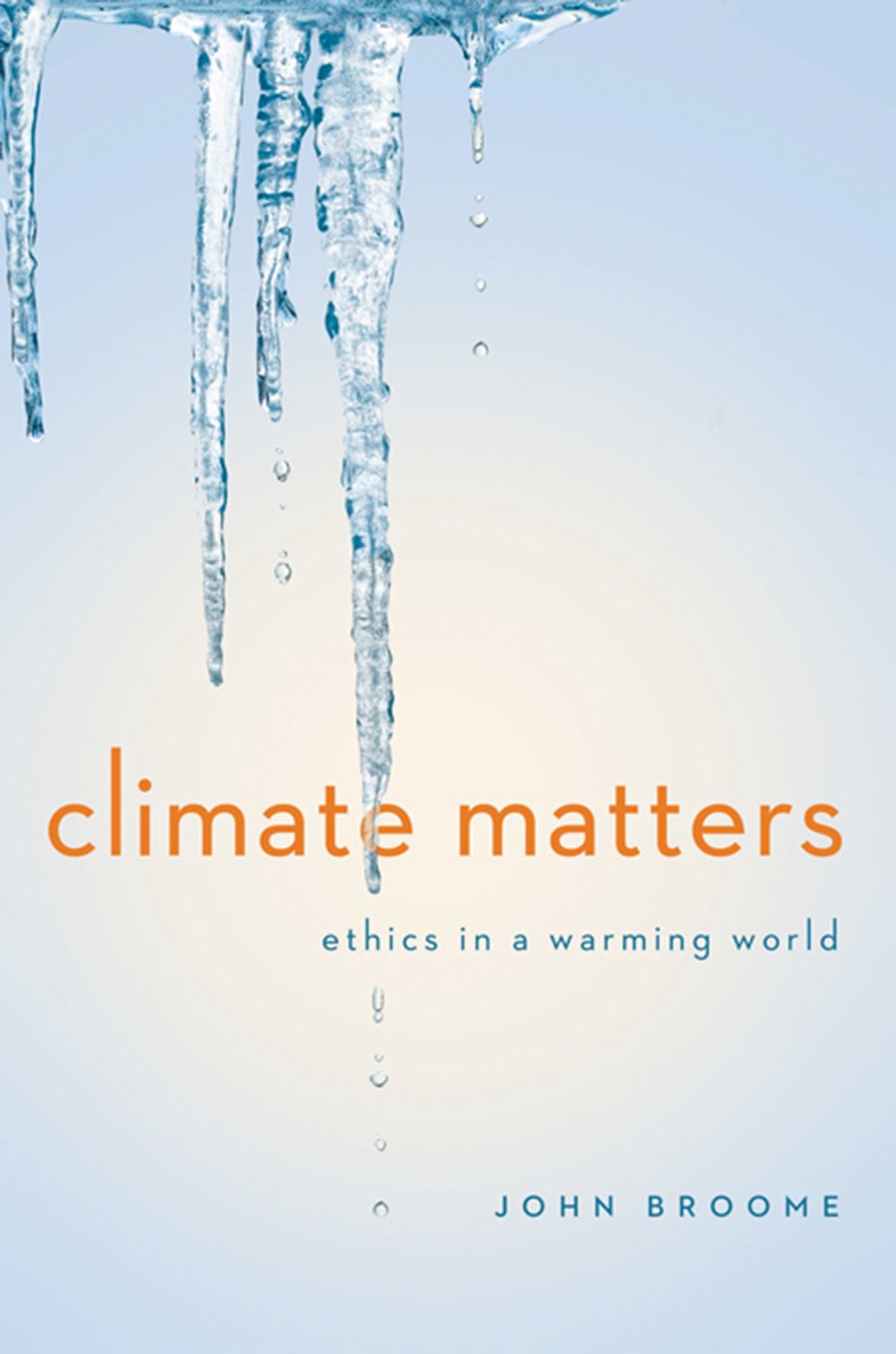
So far I read most of Climate Matters by John Broome, a philosopher at Oxford.  It is a pretty easy read and relatively short.  It's really good for a concise presentation of the important ethical considerations for climate policy and the pitfalls of economic analysis and cost-benefit analysis for climate change.

http://www.amazon.com/Climate-Matters-Ethics-Warming-ebook/dp/B007HXFGPW


I also read half of Stephen Gardiner's A Perfect Moral Storm.  It is a longer and slightly more academic exposition about ethics and climate change.  It is also very good, though.  Gardiner incorporates more citations of other prominent thinkers and more thoroughly dissects opposing arguments.

http://www.amazon.com/Perfect-Moral-Storm-Ethical-Environmental/dp/0195379446


Sunday, June 22, 2008

Family Unit

Recently, I been thinking and talking to people about families and family values. In American culture, the family means something different than in European or Chinese culture.

It's hard to generalize, but it seems that the family unit in America is smaller and not connected together in a community as much as it is in China or even Europe.

What are the implications? It would seem that the emphasis of individuality in America may be good for young entrepreneurs and the creative class. However, it leaves many behind to be content with mediocrity. Children are more influenced by peer pressure than family pressure and thus seem to try to "grow up faster," although I definitely don't think they mature faster.

I'll have to finish this post later.

Wednesday, June 18, 2008

Job Searching Schemes and Devious Thoughts

One of my goals right now is to find a job in life science research, preferably related to neuroscience and a job that does not require me to kill mice/rabbits/frogs/other vertebrates simply for a single organ or cells, or just because they have become unfit for the research. Anyway, while I am looking through university career sites as well as biotech career websites, I thought I would try out a different scheme. I would look through faculty of interest, and read a couple of their papers and then e-mail them about how much I love their work and why I would be a qualified and competent research associate.

So I printed out a couple of papers. The first one I read was a review paper related to the biomolecular mechanisms behind learning and memory, using the small marine snail Aplysia as a model of study. For a little history of the study of learning and memory in neuroscience: somewhere around the 1950's, investigators discovered that if you poke or shock (lightly, not fatally) the Aplysia, it withdraws its gill and siphon as a natural defense reflex. If you continue to shock a few times, and then lightly touch it a few hours later, it becomes sensitized to the touch stimulus, and withdraws its gill and siphon anyway even though your touch is pretty harmless. And if you continue to touch it harmlessly, it habituates and doesn't respond to touch stimuli any longer with its defense reflex. As life science research methods improved, the focus on learning and memory shifted to animals of higher complexity (such as rats and other vertebrates), and Aplysia drifted out of popularity. The paper I read essentially proposed to unify two disagreeing theories on the learning mechanisms in Aplysia, and explained that this was similar to findings in animals of 'higher intelligence'. The investigator further concluded that perhaps learning and memory mechanisms had developed early on in evolution and have been conserved through time, through natural selection. And I had an epiphany.

Neurobiology makes it difficult to believe in free will, since we are mostly controlled by mechanical, biochemical processes. So with that in mind (yes, first consider suspending free will, and then you can consider this part), I wonder if humans actually have control over their learning? We don't actually take the knowledge and concepts we want to remember and place them into our memory, we make up tactics to facilitate our ability to learn. We make up mnemonics, explain a difficult concept to ourselves a number of times before it sinks in, but we don't actually make it sink in, if that makes sense. Like the simple organism Aplysia, or even an earthworm, our learning and memory follows a few basic rules. If the basic learning and memory circuitry is essentially a passive process (aka no divine intervention, or other will at work), then why wouldn't the same be true for more complex organisms? Of course, the circuitry becomes progressively more complex as we travel through our evolutionary timeline. Complicated, yes, but still passive. Sort of like a supercomputer?

Tuesday, June 17, 2008

Words of Wisdom

Says Billy Ray Cyrus
my dad always told me the more you stomp in poop the more it stinks

Thursday, December 27, 2007

oo, 100th post

hey beth, this is for you

Hanlon's Razor states

"Never attribute to malice that which can be adequately explained by stupidity."

haha, we were researching laws like Murphy's Law and Occam's Razor and Hofstadter's Law

Tuesday, July 17, 2007

foucault

he is this french philosopher who is cool

http://en.wikiquote.org/wiki/Michel_Foucault

i was reading this book with his interviews, and he was talking about the relationship between politics and philosophy and society. I'll have to post more stuff about what he says later.