"To achieve a leadership position in supply chain sustainability, companies should have strong capabilities in data, process and governance" - CDP (Carbon Disclosure Project) - the 2013 Supply Chain Report
Yay! I'm into all those things!!
Showing posts with label climate change. Show all posts
Showing posts with label climate change. Show all posts
Friday, November 15, 2013

Tuesday, September 10, 2013
Early Signs From 2005
American RadioWorks did a series of shows called Reports from a Warming Planet.
The reports are from the work of a class taught by John Harte at ERG and environmental journalist Sandy Tolan. For most people, these anecdotes are probably much more persuasive than any scientific evidence that global warming is really happening and that it is a problem.
The reports are from the work of a class taught by John Harte at ERG and environmental journalist Sandy Tolan. For most people, these anecdotes are probably much more persuasive than any scientific evidence that global warming is really happening and that it is a problem.
Monday, September 9, 2013
Nuances About Economics
Ronald Coase was a famous economist who died recently. He came up with the Coase Theorem, which is the concept that initial allocation of an externality or good doesn't matter if there are no transaction costs (a big 'if'). In fact Coase himself acknowledges that in real economic situations, transaction costs are almost never low enough for the initial allocation not to matter. Nuances in economics are typically lost in politics. He's frequently cited by the right wing as being against governmental regulation and pro market solutions for environmental problems.
Severin Borenstein, a professor in the Haas Business School at UC Berkeley sets the record straight.
http://energyathaas.wordpress.com/2013/09/09/learning-and-forgetting-the-wisdom-of-coase/
Thursday, June 6, 2013
Climate Change Ethics
A common argument for mitigating climate change is that we have a moral imperative to future generations. Most of us don't think about this moral argument much beyond this general idea. It turns out that weighing the welfare of future generations is an unavoidable aspect of any policies that have long term impacts. As a result, ethical and philosophical considerations are important to policy analysis, cost benefit analysis, and other economic analysis of climate change mitigation. The article below gives an overview of several books about the issue.
http://www.technologyreview.com/review/513526/climate-change-the-moral-choices/
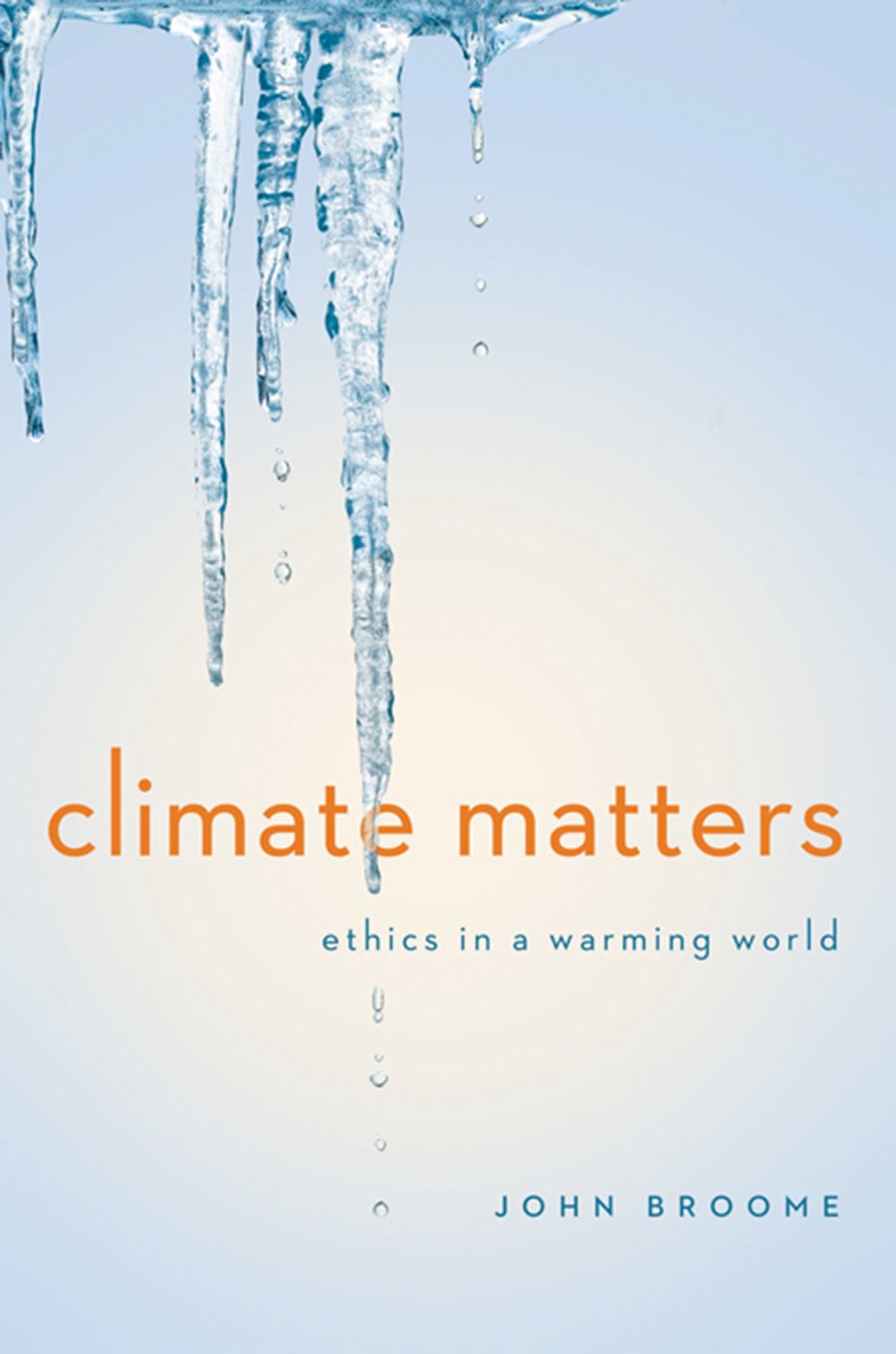
So far I read most of Climate Matters by John Broome, a philosopher at Oxford. It is a pretty easy read and relatively short. It's really good for a concise presentation of the important ethical considerations for climate policy and the pitfalls of economic analysis and cost-benefit analysis for climate change.
http://www.amazon.com/Climate-Matters-Ethics-Warming-ebook/dp/B007HXFGPW

I also read half of Stephen Gardiner's A Perfect Moral Storm. It is a longer and slightly more academic exposition about ethics and climate change. It is also very good, though. Gardiner incorporates more citations of other prominent thinkers and more thoroughly dissects opposing arguments.
http://www.amazon.com/Perfect-Moral-Storm-Ethical-Environmental/dp/0195379446

http://www.technologyreview.com/review/513526/climate-change-the-moral-choices/
So far I read most of Climate Matters by John Broome, a philosopher at Oxford. It is a pretty easy read and relatively short. It's really good for a concise presentation of the important ethical considerations for climate policy and the pitfalls of economic analysis and cost-benefit analysis for climate change.
http://www.amazon.com/Climate-Matters-Ethics-Warming-ebook/dp/B007HXFGPW
I also read half of Stephen Gardiner's A Perfect Moral Storm. It is a longer and slightly more academic exposition about ethics and climate change. It is also very good, though. Gardiner incorporates more citations of other prominent thinkers and more thoroughly dissects opposing arguments.
http://www.amazon.com/Perfect-Moral-Storm-Ethical-Environmental/dp/0195379446
Wednesday, June 1, 2011
Tuesday, May 24, 2011
Adaptation in Chicago
Chicago city planners are already making preparations for a different climate because of global warming.
Sunday, December 12, 2010
Penguins are Dying
Tragedy In Black and White
The north and south poles are affected by climate change first. Penguins and polar bears are among the species that will not be able to adjust quickly enough. And to some extent, yes, there is no human need for those animals. However, they represent what's to come for others including humans. Unfortunately, not all damage can be undone or at least will take time and a lot of effort.
Kind of depressing
The north and south poles are affected by climate change first. Penguins and polar bears are among the species that will not be able to adjust quickly enough. And to some extent, yes, there is no human need for those animals. However, they represent what's to come for others including humans. Unfortunately, not all damage can be undone or at least will take time and a lot of effort.
Kind of depressing
Wednesday, December 1, 2010
Good Venue for Climate Change Agreements
How to Change the Global Energy Conversation
Latest Breakthrough Institute article in the Wall Street Journal
Latest Breakthrough Institute article in the Wall Street Journal
Thursday, November 25, 2010
Information Flow
Sometimes more information can make us dumber.
Princeton Professor Michael Oppenheimer has done some interesting research on negative learning.
Uncertainties in scientific models such as the mechanisms of climate change can cause consensus to coalesce around wrong numerical results. This becomes a problem when policy decisions need to be made sooner than consensus can find the true value. There are a lot of reasons why this happens, but it's pretty new and interesting field of research.
(I just finished writing my essays for the Princeton STEP program.)
Princeton Professor Michael Oppenheimer has done some interesting research on negative learning.
Uncertainties in scientific models such as the mechanisms of climate change can cause consensus to coalesce around wrong numerical results. This becomes a problem when policy decisions need to be made sooner than consensus can find the true value. There are a lot of reasons why this happens, but it's pretty new and interesting field of research.
(I just finished writing my essays for the Princeton STEP program.)
Tuesday, September 7, 2010
Effect of Climate Change on Economies
Here is some interesting research done at Columbia U on how increased temperature may cause reduced economic output because of changes in human behavior and reduced productivity. I think I had first-hand experience since I had to move last week when it was in the mid-90's.
Monday, July 26, 2010
Background Info
I'm finally reading parts of the Stern Review, a report on the economics of climate change.
Sunday, July 25, 2010
Climate Legislation Abandoned
Tom Friedman says we're going to regret it.
I appreciate that he blames the public.
I could blame Republicans for the fact that not one G.O.P. senator indicated a willingness to vote for a bill that would put the slightest price on carbon. I could blame the Democratic senators who were also waffling. I could blame President Obama for his disappearing act on energy and spending more time reading the polls than changing the polls. I could blame the Chamber of Commerce and the fossil-fuel lobby for spending bags of money to subvert this bill. But the truth is, the public, confused and stressed by the last two years, never got mobilized to press for this legislation. We will regret it.
I appreciate that he blames the public.
Saturday, May 8, 2010
China Climate Change Policy: Deliberate and Wily
I went to that China Climate Change Policy talk at MIT on Friday. My Chinese isn't good enough to understand everything, but anyway the slides were in English. The presentation was an overview of the current situation of emissions and an overview of the various climate change talks that have happened like Kyoto and Copenhagen. It was fun to hear directly from the Chinese point of view even though I already know it.
Basically, much of China's energy use is in the industrial sector because half of the world's production of things like steel, aluminum, and flat glass is in China. So industrial energy use accounts for something like 70% instead of 30-40% of energy use in the US. Transportation in China accounts for 10% instead of 30% in the US. Most of electricity in China is from coal, and the presenter talked about the need to upgrade and regulate the quality of coal power plants. He also talked about how China has invested a lot of money in clean energy R&D, although he thought that it's not as much as some reports have said (like the Pew).
One thing that I thought was interesting was that he talked about how planting trees for carbon sequestration is needed, but since the carbon is just stored in the trees, it's not a continual emissions sink that can offset the use of the fossil fuels. I'm glad he brought that up because I think that point is not always presented coherently.
He talked a lot about the different climate conferences and what came of them. He pointed out that nobody is doing very well with their emissions targets set in the Kyoto treaty except for Germany, which has had something like 40% emissions reductions from 1997 levels. He also noted that Russia had a lot lower emissions, too, but I think he said it was due to a bad economy. From the Chinese point of view, it looks really bad that the US has not really made an effort at all to reduce emissions and now only promises a 17% reduction from 2005 levels by 2020, and yet there has been no progress towards that goal. On the other hand, Chinese goals don't seem that ambitious, but they have some goals for reducing carbon intensity of GDP by 40% by 2020 compared with 2005 levels, and he showed a graph for that, and they were on track for meeting that target. The speaker talked about how developed nations were supposed to commit between .5-1% of their GDP to emissions reduction, but many have not been doing that. He also summarized the tensions between the EU, US, and China/India where the EU is most frustrated with the US, but the US refuses to do anything unless China is held to the same standards. China then pushes back and wants the US to take the lead and provide more financial and technical support for developing nations. He talked about how the talks, especially COP15 compared to the UN talks, have been disorganized politically, and so China has been messing around (or something like that maybe?). From the Chinese point of view, it is a defensive strategy to protect one's interests when you see there is so much confusion and little confidence in the other parties' abilities to live up to their promises. In contrast, when China announces a domestic policy goal, they have a lot of domestic pressure to meet those goals in order to maintain legitimacy as a government.
Goals for COP16 are to figure out what kind of goals are reasonable for everyone, and how these goals can be enforced.
Basically, much of China's energy use is in the industrial sector because half of the world's production of things like steel, aluminum, and flat glass is in China. So industrial energy use accounts for something like 70% instead of 30-40% of energy use in the US. Transportation in China accounts for 10% instead of 30% in the US. Most of electricity in China is from coal, and the presenter talked about the need to upgrade and regulate the quality of coal power plants. He also talked about how China has invested a lot of money in clean energy R&D, although he thought that it's not as much as some reports have said (like the Pew).
One thing that I thought was interesting was that he talked about how planting trees for carbon sequestration is needed, but since the carbon is just stored in the trees, it's not a continual emissions sink that can offset the use of the fossil fuels. I'm glad he brought that up because I think that point is not always presented coherently.
He talked a lot about the different climate conferences and what came of them. He pointed out that nobody is doing very well with their emissions targets set in the Kyoto treaty except for Germany, which has had something like 40% emissions reductions from 1997 levels. He also noted that Russia had a lot lower emissions, too, but I think he said it was due to a bad economy. From the Chinese point of view, it looks really bad that the US has not really made an effort at all to reduce emissions and now only promises a 17% reduction from 2005 levels by 2020, and yet there has been no progress towards that goal. On the other hand, Chinese goals don't seem that ambitious, but they have some goals for reducing carbon intensity of GDP by 40% by 2020 compared with 2005 levels, and he showed a graph for that, and they were on track for meeting that target. The speaker talked about how developed nations were supposed to commit between .5-1% of their GDP to emissions reduction, but many have not been doing that. He also summarized the tensions between the EU, US, and China/India where the EU is most frustrated with the US, but the US refuses to do anything unless China is held to the same standards. China then pushes back and wants the US to take the lead and provide more financial and technical support for developing nations. He talked about how the talks, especially COP15 compared to the UN talks, have been disorganized politically, and so China has been messing around (or something like that maybe?). From the Chinese point of view, it is a defensive strategy to protect one's interests when you see there is so much confusion and little confidence in the other parties' abilities to live up to their promises. In contrast, when China announces a domestic policy goal, they have a lot of domestic pressure to meet those goals in order to maintain legitimacy as a government.
Goals for COP16 are to figure out what kind of goals are reasonable for everyone, and how these goals can be enforced.
Scientists Finally Standing Up For Themselves
Leading scientists condemn 'political assaults' on climate researchers
This is interesting and exciting because one of the things that came out during the panel talk about communicating about science was that scientists need better PR and they need spokespeople.
This is interesting and exciting because one of the things that came out during the panel talk about communicating about science was that scientists need better PR and they need spokespeople.
Thursday, May 6, 2010
China and Climate Change Policy
MIT CEER Pizza Dinner Talk: Climate Change & China's Policy
Looks like an interesting talk tomorrow. He'll be speaking in Chinese. Whoa. I'm going to go, but I probably won't be understanding that much. Haha
Speaker: Mr. Dong Song, Deputy Director of the Climate Change Office, Legal Department of the Foreign Ministry of China
Looks like an interesting talk tomorrow. He'll be speaking in Chinese. Whoa. I'm going to go, but I probably won't be understanding that much. Haha
Speaker: Mr. Dong Song, Deputy Director of the Climate Change Office, Legal Department of the Foreign Ministry of China
Climate change and its adverse effects are a common concern of the international community. As the largest greenhouse gases emitter since 2006, China?s emission trends, policies and actions in addressing climate change attract a lot of attentions from the world. This presentation will brief on the following dimensions of the issue of climate change and China: climate change and its impacts on China; emission trends of China; China?s efforts in addressing climate change; China?s positions on climate change negotiations & cooperation; China?s outlook of the forthcoming COP16 of the UNFCCC.
Speaker bio:
Mr. Dong Song has been serving as the Deputy Division Director in charge of policy planning at the Legal Department of the Foreign Ministry of China since 2009. During the period of 2006-2008, he held the post of Deputy Director of the Climate Change Office at the Legal Department of the Ministry. Now he is a Master of Arts candidate at the Fletcher School of Law and Diplomacy of the Tufts University.
Subscribe to:
Posts (Atom)