Showing posts with label electronics. Show all posts
Showing posts with label electronics. Show all posts
Monday, June 13, 2011

Sunday, June 5, 2011
Testing Batteries
Nice overview on battery performance specs. I'm testing Lithium Polymer batteries for work. I also need to come up with a system for the production team to check batteries for degradation.
Tuesday, May 24, 2011
Friday, January 14, 2011
New Products at Electronica Trade Show
EDN has an interesting article IC Vendors Seek Green Applications
Monday, October 4, 2010
RFID Sensors in Florida
I just got caught up with a former coworker from Tagsense, who is now working at Locus Traxx, which is a small engineering firm in Florida. They are using some Tagsense products in some of their products to make sensors and energy harvesters. They are using piezo energy harvesters but also looking into this new kind for wind power. They were also making some sensors to sense the oil in the ocean from the BP oil spill. I wonder if fish will just eat those things, though. I may be able to do an internship there for the spring, which would be really cool.
Monday, August 17, 2009
New Equipment
Got a new laptop today. The Acer Aspire One D250. It seemed like the one in the store had a good videocam.
Wednesday, May 20, 2009
Saturday, April 4, 2009
Tuesday, March 24, 2009
Not So Fast
Tuesday, March 3, 2009
Tuesday, February 3, 2009
Monday, January 19, 2009
BYD E6 Electric Car
BYD is a Chinese battery company, and they made a car. Seems awesome. It could be sold in Europe by 2010.
So far, all we know is that the E6 will be a 5 seater with an acceleration of 0 to 100 kph of around 10 seconds. Top speed should be top speed of 160 kph (100 mph), and the battery pack, which is located under the rear passenger seats, will be based on BYD's own lithium-ion iron phosphate technology. Range per charge is expected to be 300 km (186 miles).
But most impressive of all:
"BYD projected the battery had a life of 2,000 cycles, for a lifetime range of about 600,000 km (373,000 miles)"
Wow! Even if thats just half true, it's still pretty good.
Friday, August 22, 2008
Places to Put Solar Panels
I was listening to NPR the other day, and they were talking about a cruise ship company that will be putting solar panels on their ships. Haha. There are probably lots of other good places to lobby for to put solar panels on. What about on top of our cars and buses?
Sunday, July 27, 2008

Sunday, July 13, 2008
Electronics Kit

So, for WTP EE class, we have them use this kit, but today I saw a kit at Radioshack is that pretty much just as good, if not better, and is less than half the price. Wow. In fact if you wanna learn some EE, I recommend this kit.

Friday, July 11, 2008
Next Generation Cars
I thought I'd do an overview of people and projects related to cars.
We took the WTP girls to the Media Lab today for a tour. We looked at the Smart Cities Group's City Car. They have a "robot" electric car, which can be steered by joystick or whatever controller you want, really. This brings up interesting issues with putting limitations on what a user should be allowed to do in the interest of safety. Anyway,
I was surfing for other projects related to cars, and there's this other group that is working on a fully automatic steering vehicle in CSAIL. They competed and did ok in the DARPA Urban Challenge. They got beat out by Carnegie Mellon, Stanford, and Virgina Tech. Tsk tsk.
We took the WTP girls to the Media Lab today for a tour. We looked at the Smart Cities Group's City Car. They have a "robot" electric car, which can be steered by joystick or whatever controller you want, really. This brings up interesting issues with putting limitations on what a user should be allowed to do in the interest of safety. Anyway,
I was surfing for other projects related to cars, and there's this other group that is working on a fully automatic steering vehicle in CSAIL. They competed and did ok in the DARPA Urban Challenge. They got beat out by Carnegie Mellon, Stanford, and Virgina Tech. Tsk tsk.
Wednesday, June 18, 2008
Power Electronics Lecture
There are 3 EE tutors, and I am one of them. We are each doing a lecture. I'm going to do one on power electronics. I will probably just talk about transformers. I only have 20 min, though.
First, I'd probably talk about what power converters do to give them an overview of what is power electronics.
There's AC/AC, AC/DC (wall-warts), DC/DC (computer supply), DC/AC (not sure when this happens).
Transformers are useful for all types of power converters, but most obviously, AC/AC.
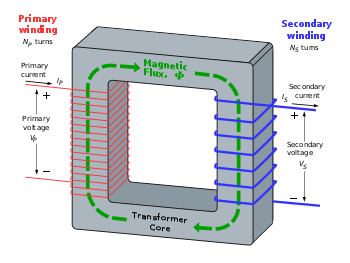
A transformer is two inductors that share magnetic flux.
ok ok ok, let's look at one inductor first. Besides the electrical behavior of an inductor, it also produces a magnetic field so that it looks like a magnet.
If you put two inductors close together like this, they share magnetic field, and the magnetic field created in one induces current in the other.
What is the math behind all this? V = L*di/dt
Faraday's law of induction states that V = N * dPhi/dt where Phi is magnetic flux.
In order to maximize the current induced in the other, we want to maximize the amount of magnetic flux that flows through the second inductor. We do this by wrapping the inductors around certain materials.
All materials have a magnetic permeability. The permeability of air is low and is almost the same as the permeability of a vacuum, which is referred to as the permeability of free space.
Iron has high permeability, so ferrite is often used in transformers.

It depends how they are wound, but in the most general configuration, the turns ratio dictates the relative voltages and currents. Vs = Vp*Ns/Np and Is = Ip*Np/Ns

First, I'd probably talk about what power converters do to give them an overview of what is power electronics.
There's AC/AC, AC/DC (wall-warts), DC/DC (computer supply), DC/AC (not sure when this happens).
Transformers are useful for all types of power converters, but most obviously, AC/AC.
A transformer is two inductors that share magnetic flux.
ok ok ok, let's look at one inductor first. Besides the electrical behavior of an inductor, it also produces a magnetic field so that it looks like a magnet.
If you put two inductors close together like this, they share magnetic field, and the magnetic field created in one induces current in the other.
What is the math behind all this? V = L*di/dt
Faraday's law of induction states that V = N * dPhi/dt where Phi is magnetic flux.
In order to maximize the current induced in the other, we want to maximize the amount of magnetic flux that flows through the second inductor. We do this by wrapping the inductors around certain materials.
All materials have a magnetic permeability. The permeability of air is low and is almost the same as the permeability of a vacuum, which is referred to as the permeability of free space.
Iron has high permeability, so ferrite is often used in transformers.

It depends how they are wound, but in the most general configuration, the turns ratio dictates the relative voltages and currents. Vs = Vp*Ns/Np and Is = Ip*Np/Ns
Sunday, June 15, 2008
Efficient Products
This consumer information site only has limited information, but the have info about computers and monitors and battery chargers.
Monday, March 17, 2008
Sunday, March 2, 2008
IT WORKS AHHHHH
WOW I FINALLY GOT THESE TRANSCEIVERS TO TRANSMIT AND RECEIVE DATA!!!!!!!!!!!!!1
AMAZING!! I AM HIGH RIGHT NOW FROM THAT. I wasn't sure I was going to be able to do it because I really need to get going on my project and maybe switch to a different device. WHEW
I'm using CC2500. I don't think I would recommend them, though. But I don't really know what the alternatives are really like. It seems very difficult. There must be a better way...
AMAZING!! I AM HIGH RIGHT NOW FROM THAT. I wasn't sure I was going to be able to do it because I really need to get going on my project and maybe switch to a different device. WHEW
I'm using CC2500. I don't think I would recommend them, though. But I don't really know what the alternatives are really like. It seems very difficult. There must be a better way...
Subscribe to:
Posts (Atom)