Showing posts with label power electronics. Show all posts
Showing posts with label power electronics. Show all posts
Sunday, June 5, 2011
Testing Batteries
Nice overview on battery performance specs. I'm testing Lithium Polymer batteries for work. I also need to come up with a system for the production team to check batteries for degradation.

Monday, December 28, 2009
Gingerbread Circuits


Smark and I made gingerbread circuits. Well, Smark's mom made the gingerbread, and then we put candy on it. We actually made them to resemble actual units from my work. The smaller one is a DC-DC converter and the larger one is part of a Max Power Point Tracker for solar panels to charge batteries.
Saturday, October 31, 2009
I Am Useful
Naval Research Lab Fuel Cell Unmanned Air Vehicle Completes 23-Hour Flight
Found out this drone uses a product I helped bring to market earlier this year. It is a non-isolated DC-DC converter that has current limiting capability, making to useful for charging batteries. There were a lot of problems with it when I first started working on it. To prevent current from flowing from the output to the input, there are FETs on the output that only turn on when the unit is enabled. When I first worked on it, I could not figure out why the unit was getting so hot even when there was no load. Finally, I blew up those FETs somehow, and we realized that they were not getting turned on, and that the unit was working because the current was going through the body diode of those FETs.
It's exciting to see it actually be used for something, especially in cutting edge research, even if it is a military application, haha.
Found out this drone uses a product I helped bring to market earlier this year. It is a non-isolated DC-DC converter that has current limiting capability, making to useful for charging batteries. There were a lot of problems with it when I first started working on it. To prevent current from flowing from the output to the input, there are FETs on the output that only turn on when the unit is enabled. When I first worked on it, I could not figure out why the unit was getting so hot even when there was no load. Finally, I blew up those FETs somehow, and we realized that they were not getting turned on, and that the unit was working because the current was going through the body diode of those FETs.
It's exciting to see it actually be used for something, especially in cutting edge research, even if it is a military application, haha.
Tuesday, March 24, 2009
Not So Fast
Monday, March 9, 2009
Saturday, August 16, 2008
EnergyQor
I just finished two weeks at my job. I'm in the failure analysis group, which means I debug failed units. It's fun.
Synqor is a power electronics company which makes DC/DC converters. They have a handful of product lines. I've mostly been working with the PowerQor product line, which usually converts higher DC voltage, like 48V to lower voltage like 5V. They come in sizes called half-brick, quarter brick, eigth brick, and 16th brick. They usually can source at least 20 amps, and they are extremely efficient. To put into perspective, your average laptop power supply can source up to maybe 2 amps, and it's the size of one of their half brick ones, which can usually source 50 amps. An efficient desktop computer power supply is 80% efficient. All the PowerQors are at least 90% efficient. Usually they're 95% or even 98% efficient. As a company, they are still privately owned but growing. They are doing well in today's market since highly efficient and cool (temperature) converters are hot now.
Here's a datasheet for a quarter brick 5V 30A converter. I've been looking at a lot of things like this.
Synqor is a power electronics company which makes DC/DC converters. They have a handful of product lines. I've mostly been working with the PowerQor product line, which usually converts higher DC voltage, like 48V to lower voltage like 5V. They come in sizes called half-brick, quarter brick, eigth brick, and 16th brick. They usually can source at least 20 amps, and they are extremely efficient. To put into perspective, your average laptop power supply can source up to maybe 2 amps, and it's the size of one of their half brick ones, which can usually source 50 amps. An efficient desktop computer power supply is 80% efficient. All the PowerQors are at least 90% efficient. Usually they're 95% or even 98% efficient. As a company, they are still privately owned but growing. They are doing well in today's market since highly efficient and cool (temperature) converters are hot now.
Here's a datasheet for a quarter brick 5V 30A converter. I've been looking at a lot of things like this.
Wednesday, June 18, 2008
Power Electronics Lecture
There are 3 EE tutors, and I am one of them. We are each doing a lecture. I'm going to do one on power electronics. I will probably just talk about transformers. I only have 20 min, though.
First, I'd probably talk about what power converters do to give them an overview of what is power electronics.
There's AC/AC, AC/DC (wall-warts), DC/DC (computer supply), DC/AC (not sure when this happens).
Transformers are useful for all types of power converters, but most obviously, AC/AC.
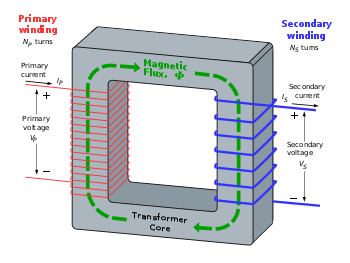
A transformer is two inductors that share magnetic flux.
ok ok ok, let's look at one inductor first. Besides the electrical behavior of an inductor, it also produces a magnetic field so that it looks like a magnet.
If you put two inductors close together like this, they share magnetic field, and the magnetic field created in one induces current in the other.
What is the math behind all this? V = L*di/dt
Faraday's law of induction states that V = N * dPhi/dt where Phi is magnetic flux.
In order to maximize the current induced in the other, we want to maximize the amount of magnetic flux that flows through the second inductor. We do this by wrapping the inductors around certain materials.
All materials have a magnetic permeability. The permeability of air is low and is almost the same as the permeability of a vacuum, which is referred to as the permeability of free space.
Iron has high permeability, so ferrite is often used in transformers.

It depends how they are wound, but in the most general configuration, the turns ratio dictates the relative voltages and currents. Vs = Vp*Ns/Np and Is = Ip*Np/Ns
First, I'd probably talk about what power converters do to give them an overview of what is power electronics.
There's AC/AC, AC/DC (wall-warts), DC/DC (computer supply), DC/AC (not sure when this happens).
Transformers are useful for all types of power converters, but most obviously, AC/AC.
A transformer is two inductors that share magnetic flux.
ok ok ok, let's look at one inductor first. Besides the electrical behavior of an inductor, it also produces a magnetic field so that it looks like a magnet.
If you put two inductors close together like this, they share magnetic field, and the magnetic field created in one induces current in the other.
What is the math behind all this? V = L*di/dt
Faraday's law of induction states that V = N * dPhi/dt where Phi is magnetic flux.
In order to maximize the current induced in the other, we want to maximize the amount of magnetic flux that flows through the second inductor. We do this by wrapping the inductors around certain materials.
All materials have a magnetic permeability. The permeability of air is low and is almost the same as the permeability of a vacuum, which is referred to as the permeability of free space.
Iron has high permeability, so ferrite is often used in transformers.
It depends how they are wound, but in the most general configuration, the turns ratio dictates the relative voltages and currents. Vs = Vp*Ns/Np and Is = Ip*Np/Ns
Saturday, April 12, 2008
ELI THE ICE MAN
in my power electronics class today, my professor told us about ELI THE ICE MAN, a mnemonic for remembering that when the load looks inductive, the voltage leads the current, and when the load looks capacitive, the current leads the voltage. we were like ... what!? eli the ice man? and then he cooked some eggs on a loud resonant pole inverter. and then i found out that if you pull on your ears a certain way, you don't hear high frequencies very well anymore.
Thursday, February 21, 2008
Wednesday, February 20, 2008

Friday, February 15, 2008
synqor
This power electronics company called SynQor offered me a job. I think I'm going to take it.
About SynQor
The interviewing was intense. I was actually hoping to move west to CA, but this company is really cool so I guess I'm going to be moving a little bit west. Haha. It's located 30 min west of davis square. The founder and president of the company used to be an MIT professor, and he is one of the authors of my power electronics book. I was really surprised to get an offer right then and there. The veep also talked to me for a long time about the organization of the company and the rotational program they have for new employees, where they eventually train you to be an electrical design engineer over a 3-5 year period. This company is serious about mentoring and it's horizontal organization structure, which is really important for me. YAY
About SynQor
The interviewing was intense. I was actually hoping to move west to CA, but this company is really cool so I guess I'm going to be moving a little bit west. Haha. It's located 30 min west of davis square. The founder and president of the company used to be an MIT professor, and he is one of the authors of my power electronics book. I was really surprised to get an offer right then and there. The veep also talked to me for a long time about the organization of the company and the rotational program they have for new employees, where they eventually train you to be an electrical design engineer over a 3-5 year period. This company is serious about mentoring and it's horizontal organization structure, which is really important for me. YAY
Tuesday, December 25, 2007
Universal Powerline
I was reading about something that people are working on. The dream is to get internet from the wall warts. Then, computers will all the networked as soon as you plug them in. Sounds pretty cool. Wonder if it will go anywhere. Universal Powerline Association
Saturday, November 24, 2007
USBCELL

http://www.usbcell.com/
These things are so cool. They're not really that new, but it's the first time I saw their AAA batteries. They plug into your USB port to recharge by having a folding USB port! I'm going to try to get a job with these people.
Friday, October 26, 2007
Hand Crank Generator
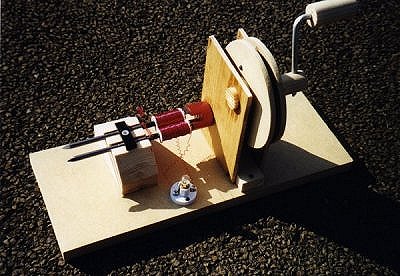
I think I'm going to make a hand crank generator for my final project in Power Electronics. I'd like it to an mp3 player and speakers so that we can have a hand crank music box that plays mp3s, haha.
Monday, July 16, 2007
wireless power
oh yeah, so I read edn magazine (electronics design, strategy, news) and in the july issue they talk about wireless power. this company is cool. http://www.powercastco.com/
maybe i can work for them when i grow up!
maybe i can work for them when i grow up!
Subscribe to:
Comments (Atom)