After watching Nirvana in Fire I read up a bit more about Chinese history. Popular narratives in China about Chinese history are especially important to understanding the Chinese perspective on the responsibilities of governments. I wrote about how this relates to Nirvana in Fire in a Fold story.
In other news, I started trying to read it in Chinese. The story actually started out as an internet novel. Then I bought a paperback copy from Amazon. To my shock, they were not the same! Thankfully, someone on the internet explains that there are multiple editions because the author typically polishes it when they go to publish the story as a book. The internet version is the modern equivalent of weekly installments in the newspaper so it's often more long-winded, Dicken's style.
Showing posts with label book. Show all posts
Showing posts with label book. Show all posts
Friday, December 25, 2015

Tuesday, January 6, 2015
Ethical Mice

My interest in corporate social responsibility and climate change has led me to reflect on the role of ethics in industry. Reading "Flash Boys" by Michael Lewis, "Moral Mazes" by Robert Jackall, and a collection of books and articles has given me a better idea about decision-making inside corporations and the challenges of regulating businesses. Many of these challenges seem to be outside the standard microeconomic framework that currently dominates policy analysis. In that framework, ethics seems quaint, but perhaps there really is no replacement.
There are many reasons to regulate the private sector: minimize pollution, improve worker safety, ensure fair prices, combat fraud, etc. If everyone's incentives were aligned then there would be no reason for rules to be enforced. In the standard economic analysis framework, the misalignment of incentives cause "market failures." This means that harms, known as negative externalities, are not being accounted for in the markets of the offending products. (They might lead to more spending in the markets such as the market for medicine). The market failures are caused by things like transactional frictions, principal-agent problems, and asymmetric information. Solutions to market failures involve regulating the private sector one way or another. The objective is to align the incentives of producers with the interests of society by increasing the cost of causing externalities through fines or taxes.
In applying this framework, welfare is typically equated with monetary value. Then businesses and individuals in them respond exclusively to monetary incentives, their decisions driven by exacting cost-benefit analysis. The cost of regulating then, is proportional to the amount the business stands to gain from the activity.
Is this the whole story? Does this mean ethics is irrelevant?
First I want to point out that the motivation to avoid regulation is proportional to how much "individuals" have to gain. This is not always the the same thing as the amount the business has to gain overall because the individual is primarily concerned with his/her own career. This is generally true for decisions in an organization. In other words, if an initiative has the potential to cause one manager to gain recognition and a bonus rather than sharing credit with other managers, that initiative is more likely to be championed and thus implemented. For example, according to Nassim Taleb in "Black Swan," a contributing cause to the subprime mortgage crisis was the misalignment of individuals and the business. The analysis of risk management divisions in banks were often ignored because individuals in the trading divisions stood to gain fantastically from increasingly risky activities.
Next, let us inspect the costs of regulation more carefully. At first glance, the cost is simply the size of the fine, subsidy, or tax. Most analysts also take into consideration the likelihood that the fine or analogous costs will be incurred. The cost to the regulating body of administering these programs and auditing activities is often left out of economic analyses. Both the regulators and the businesses participate in auditing and accounting activities, although for different purposes. The higher the tax, the more resources businesses will allocate towards evading it by either by masking its activities in its own accounting system or lobbying to cut the budget of the regulator. It is possible to make information arbitrarily difficult and time-consuming to assess, which greatly increases the cost to regulators. In Flash Boys, the exchanges created complicated order types. In addition, the documentation to the SEC about these order types seemed purposefully more complicated than they needed to be.
Complicity among individuals in the industry is another driving factor for the cost of regulating behavior. If all the businesses participate in obfuscating their activities, then they can all maintain the illusion that the level of complexity is necessary. Idolizing neoclassical economics and the free market at the expense of ethics then is very convenient for those who stand to gain. Believing in the wisdom of the invisible hand means that the value of one's work is evidenced by the amount one is paid. Those who feel no need to question the purpose of their activities can be counted on to be complicit.
Even if regulators manage to administrate a program, they still may not have enough resources or information to assess the effectiveness of the program. Measuring effectiveness often requires some additional information. For example, the Reg NMS rule sought to make markets more fair by mandating that financial intermediaries must trade public equities at the best price. However, financial intermediaries found other ways to scalp investors. Regulators neglected to collect the information needed to assess the prevalence of other kinds of unfair practices.
By now it should be clear that regulating private sector activities is often an elaborate cat and mouse game. A few fat mice are more strongly motivated and can more easily collaborate than millions of mice. The smartest cat must be at least as smart as the smartest mice or else the mice can easily confuse the cat.
Many conclude that regulating is indeed hopeless in many situations. Brad and his team gave up on the SEC, who had no ability to compete with Wall Street for the talent required to regulate. In order to sell his idea, Brad had to adopt rhetoric about being "long-term greedy." But in fact he was personally very compelled to take on the system because it is not "right." It is significant to me that only those who with an ideal about fairness even dared to pursue a market solution. Only ethics can provide enough drive to an individual to overcome the risk, the likelihood of a lower payoff, and the stress from causing extreme conflict among peers.
The culture around ethics and the purpose of one's job perhaps should be considered as another tool in policy-making. The structure of incentives in an organization governs the behavior of individuals. Moral Mazes describes the incentive structure of a hierarchical bureaucracy typical of large public corporations. There are many similarities with the environment and culture of these corporations with that of Wall Street exchanges and investment banks as described in "Flash Boys."
It may be possible to modify the standard framework of policy analysis to include this kind of ethical motivation as a part of individuals' welfare functions. It's not clear to me whether that is the most helpful approach. Instead, the study of polycentric systems an cooperation could potentially be applied to such environments in order to increase the value of transparency and ethical behavior. There may also be analytic tools from complexity theory and behavioral economics.
My theory now is that for any given industry, a minimum number of individuals with resources and talent who commit to acting ethically is needed to stunt the efforts of those who are amoral. On the flip side, a minimum number of talented amoral individuals is needed in order to implement an injustice. Complicity with an amoral system ultimately perpetuate the injustice systemically. It follows then that conviction matters. Resolve matters. Ethics matter.
Thursday, September 11, 2014
Debate About Fairness of the Stock Market
Throwdown!
It's Brad Katsuyama, the founder of IEX, a new exchange that touts itself as being more fair for investors. Michael Lewis joins him in defending what he wrote in Flash Boys. On the attack on behalf of HFT is Bill O'Brien, then president of the BATS exchange.
Since the debate, the BATS exchange had to issue a statement correcting something O'Brien said, and O'Brien has gotten fired.
http://www.efinancialnews.com/story/2014-07-22/bats-global-president-william-obrien-exits?ea9c8a2de0ee111045601ab04d673622
It's Brad Katsuyama, the founder of IEX, a new exchange that touts itself as being more fair for investors. Michael Lewis joins him in defending what he wrote in Flash Boys. On the attack on behalf of HFT is Bill O'Brien, then president of the BATS exchange.
Since the debate, the BATS exchange had to issue a statement correcting something O'Brien said, and O'Brien has gotten fired.
http://www.efinancialnews.com/story/2014-07-22/bats-global-president-william-obrien-exits?ea9c8a2de0ee111045601ab04d673622
Monday, August 4, 2014
Romance of the Three Kingdoms
The Romance of the Three Kingdoms probably wouldn't count as a pillar of Chinese culture, but it should be at least a gargoyle. It's a novel from the 14th century attributed to Luo Guanzhong. It is a dramatic retelling of the struggles between the three kingdoms in the 2nd and 3rd century in China. There are many many Chinese movies and TV shows and other adaptations about this period of time based on this novel. Sometimes they decide to be more accurate than the novel, sometimes less accurate.
I've heard the names of various characters for years but never really knew what they did or the whole story. I've recently watched several movies based on this period of time, the most notable of which is Red Cliff, and read about the Three Kingdoms on Wikipedia. I found that the prevalence of the story in Chinese culture is kind of like the Trojan Wars and the rise and fall of Julius Caesar. Now I feel that learning about history and classic stories such as this is actually an essential part of learning the Chinese language if the primary goal is to communicate with Chinese people. These stories illustrate the Chinese thought process as well as values, which in many ways is more important to communicating than words. I wish this was a greater focus during Chinese school when I was growing up.
I've heard the names of various characters for years but never really knew what they did or the whole story. I've recently watched several movies based on this period of time, the most notable of which is Red Cliff, and read about the Three Kingdoms on Wikipedia. I found that the prevalence of the story in Chinese culture is kind of like the Trojan Wars and the rise and fall of Julius Caesar. Now I feel that learning about history and classic stories such as this is actually an essential part of learning the Chinese language if the primary goal is to communicate with Chinese people. These stories illustrate the Chinese thought process as well as values, which in many ways is more important to communicating than words. I wish this was a greater focus during Chinese school when I was growing up.
Sunday, July 27, 2014
Michael Lewis
Michael Lewis is a best selling author of non-fiction books. I just got a copy of "Flashboys" today, which is about how high frequency trading is a vehicle for many unfair practices in financial markets. In promoting the book as well as his ideas, he's been making the rounds on TV and the internet.
He is surprisingly willing to call the stock market rigged against retail investors. He is also very good at fielding criticism. I am impressed with how good he is at not letting the interviewers change the topic.
Here's a long Charlie Rose interview.
He also has an hour-long interview with Conan O'Brien for Serious Jibber Jabber
http://teamcoco.com/video/serious-jibber-jabber-michael-lewis
And he lives in Berkeley!
He is surprisingly willing to call the stock market rigged against retail investors. He is also very good at fielding criticism. I am impressed with how good he is at not letting the interviewers change the topic.
Here's a long Charlie Rose interview.
He also has an hour-long interview with Conan O'Brien for Serious Jibber Jabber
http://teamcoco.com/video/serious-jibber-jabber-michael-lewis
And he lives in Berkeley!
Thursday, June 19, 2014
Public Corporations and Investors: Theory vs. Reality
It's conventional knowledge, in the business world at least, that a corporation's primary purpose is to maximize shareholder value. A corporation can only hope to maximize benefits to everyone through maximizing shareholder value. This idea is often presented as a law of the universe as immutable as the laws of physics. In The Shareholder Value Myth by Lynn Stout makes a persuasive case that maximizing shareholder value is not always the best for the corporation, the market, or society. Stout is a law professor at Cornell specializing in corporate governance law. She argues that corporations are not legally required to maximize shareholder value at the exclusion of other goals. Furthermore, the focus on stock price leads corporations to destroy fundamental value in favor of short-term gains, which is against the long-term interests of many shareholders as well. Instead, corporations should invest in their employees and their communities to maximize long-term benefits.
I recommend anyone who is interested in corporate governance, business management, economics, finance, or social entrepreneurship to read this. It is a fairly short and quick read, but since many people still won't read it, I will summarize the main points here.
Shareholder primacy is the principle that the corporation's sole purpose is to increase shareholder value because this maximizes the welfare of the corporation as well as society at the same time. This means that a corporation's performance is based completely on one number, and that is the stock price. Yes, it is very conceptually elegant, not to mention convenient, if this were true. This idea became popular in the 1980's coinciding with the rise of neoclassical economic theory. (Although there is nothing wrong with neoclassical theory itself, it is often misapplied. More on this later). Since then, conviction in shareholder primacy became so strong that everyone believes that corporations have a fiduciary duty to maximize shareholder primacy and that this duty is enforced legally.
It's Not Legally Required
Lynn Stout's first point is that shareholder primacy is actually not a legal requirement. The case that is typically cited to demonstrate legal fiduciary duty to shareholders is Dodge v. Ford 1916 where Dodge was a minority shareholder in Ford Motor Company. The court ruled that Henry Ford could not reduce the dividends to shareholders such as the Dodge brothers to build more plants and pay his employees more while profit was increasing. Stout argues that the ruling is outdated as well as irrelevant because
Instead, directors of public corporations have protection under the "business judgment rule," where corporations can do anything as long as it is lawful and directors do not have personal conflicts of interest.
The Theory is Flawed
Stout's second and perhaps more interesting point is that economic theory is being misapplied to corporate governance. The theory behind shareholder primacy is that shareholders are the owners and thus residual claimants of a corporation's profits. They are the principals while directors are the agents and therefore if the agents maximize the welfare of the principals, welfare should be maximized overall. This idea was popularized by Milton Friedman, a prominent neoclassical economist. However, Stout argues that the principal-agent relationship isn't really descriptive of the relationship between the shareholder and corporation because
Justifying Myopic Behavior in the Finance Industry
Another very rich topic that Stout digs into is how the realities of the finance industry interact with shareholder primacy to encourage myopic behavior in corporations and investors. Short-term investing has been increasing. By 2010, public stock is held for four months on average compared to eight years in 1960. Therefore, even though investors should theoretically be primarily interested in long-term corporate performance, clearly many are profiting from short term gains. An investor who only plans on holding a stock for a short time can and do lobby for actions that increase the stock price in the short term, after which the investor sells, thus relinquishing her interest in the long-term success of the corporation. In fact, it would be good for these investors if the stock price subsequently went down so that she can invest again and start the cycle over. Myopic behaviors include cutting back on R&D or marketing or laying off employees to boost quarterly earnings reports. They also include splitting up the company, selling off assets, and getting acquired.
These things happen because shareholders (and thus investors) are heterogeneous in their expertise as well as incentives. Also, information is expensive and time consuming, especially more qualitative information as opposed to prices. Long-term investors profit from the overall performance of the market. They will hold diversified assets in order to reduce risk. As a result, they "suffer" from rational apathy. There is too much information and their stake in each company is so small that it is not worth it to investigate whether a company's earnings went up because of myopic behavior or because of a particularly successful new product or operational improvements. In contrast, shareholders who are more involved in corporate governance are usually short-term investors who profit from buying and selling. They will hold relatively large stakes in a small number of companies, and it is in their interest to create "news" that will change expectations one way or another. Yes, the market eventually "corrects itself," but the profits and losses from the error and subsequent correction are real. Misallocation of financial capital, hurting employee morale, losing talent, slower innovation, lower quality products, reduced customer loyalty are sometimes also tangible and lasting effects. Another dynamic that exacerbates the prevalence of these behaviors is that long-term investors such as institutional investors, who invest on behalf of pensioners for example, hire active managers to manage large portions of their assets. These active managers are judged by their quarterly performance. As a result, they are often short-term investors because those strategies are more reliable as well as profitable.
Recommendations
Ok, that sounds like a hairy mess. Stout's recommendations aren't as crisp as her analysis of the situation. Even so, there are four potential solutions that stood out to me.
I recommend anyone who is interested in corporate governance, business management, economics, finance, or social entrepreneurship to read this. It is a fairly short and quick read, but since many people still won't read it, I will summarize the main points here.
Shareholder primacy is the principle that the corporation's sole purpose is to increase shareholder value because this maximizes the welfare of the corporation as well as society at the same time. This means that a corporation's performance is based completely on one number, and that is the stock price. Yes, it is very conceptually elegant, not to mention convenient, if this were true. This idea became popular in the 1980's coinciding with the rise of neoclassical economic theory. (Although there is nothing wrong with neoclassical theory itself, it is often misapplied. More on this later). Since then, conviction in shareholder primacy became so strong that everyone believes that corporations have a fiduciary duty to maximize shareholder primacy and that this duty is enforced legally.
It's Not Legally Required
Lynn Stout's first point is that shareholder primacy is actually not a legal requirement. The case that is typically cited to demonstrate legal fiduciary duty to shareholders is Dodge v. Ford 1916 where Dodge was a minority shareholder in Ford Motor Company. The court ruled that Henry Ford could not reduce the dividends to shareholders such as the Dodge brothers to build more plants and pay his employees more while profit was increasing. Stout argues that the ruling is outdated as well as irrelevant because
- Ford was not a public corporation. It was a closely held corporation where the majority shareholder (Henry Ford) had a duty to look out for the interests of minority shareholders (Dodge).
- The comment that supports shareholder primacy, "a business corporation is organized and carried on primarily for the profit of the stockholders" was a "dicta." In other words, it was not part of the legal rationale for the decision and therefore does not set legal precedent.
- It is an old ruling.
- It was a ruling from the Michigan Supreme Court, which is not considered an authoritative source for corporate law compared to Delaware, where many more companies are incorporated.
Instead, directors of public corporations have protection under the "business judgment rule," where corporations can do anything as long as it is lawful and directors do not have personal conflicts of interest.
The Theory is Flawed
Stout's second and perhaps more interesting point is that economic theory is being misapplied to corporate governance. The theory behind shareholder primacy is that shareholders are the owners and thus residual claimants of a corporation's profits. They are the principals while directors are the agents and therefore if the agents maximize the welfare of the principals, welfare should be maximized overall. This idea was popularized by Milton Friedman, a prominent neoclassical economist. However, Stout argues that the principal-agent relationship isn't really descriptive of the relationship between the shareholder and corporation because
- Shareholders do not legally or practically own corporations. In fact corporations own themselves. Shareholders own a share, which is a contract with some limited rights.
- Shareholders are not the residual claimants. The idea that they are comes from bankruptcy law, where the shareholders get whatever is left over after other contractual obligations are fulfilled as a company is being liquidated. However, a company being liquidated is completely different from a living company, which has to plan for the future.
- Shareholders are not principals. Corporations are created before there are shareholders, but principals should exist before agents.
- The share price alone (probably) cannot be used to measure the worth of a company. First of all, it doesn't really make sense to use something that fluctuates constantly. Second of all, because of frictions that come with doing business in real life, a corporation can cause many externalities (public harm) while privatizing the benefits. These externalities ultimately lower the quality of life of the public, including shareholders. Stout claims that externalities can and do harm the private sector as well, stunting the growth of the market overall.
Justifying Myopic Behavior in the Finance Industry
Another very rich topic that Stout digs into is how the realities of the finance industry interact with shareholder primacy to encourage myopic behavior in corporations and investors. Short-term investing has been increasing. By 2010, public stock is held for four months on average compared to eight years in 1960. Therefore, even though investors should theoretically be primarily interested in long-term corporate performance, clearly many are profiting from short term gains. An investor who only plans on holding a stock for a short time can and do lobby for actions that increase the stock price in the short term, after which the investor sells, thus relinquishing her interest in the long-term success of the corporation. In fact, it would be good for these investors if the stock price subsequently went down so that she can invest again and start the cycle over. Myopic behaviors include cutting back on R&D or marketing or laying off employees to boost quarterly earnings reports. They also include splitting up the company, selling off assets, and getting acquired.
These things happen because shareholders (and thus investors) are heterogeneous in their expertise as well as incentives. Also, information is expensive and time consuming, especially more qualitative information as opposed to prices. Long-term investors profit from the overall performance of the market. They will hold diversified assets in order to reduce risk. As a result, they "suffer" from rational apathy. There is too much information and their stake in each company is so small that it is not worth it to investigate whether a company's earnings went up because of myopic behavior or because of a particularly successful new product or operational improvements. In contrast, shareholders who are more involved in corporate governance are usually short-term investors who profit from buying and selling. They will hold relatively large stakes in a small number of companies, and it is in their interest to create "news" that will change expectations one way or another. Yes, the market eventually "corrects itself," but the profits and losses from the error and subsequent correction are real. Misallocation of financial capital, hurting employee morale, losing talent, slower innovation, lower quality products, reduced customer loyalty are sometimes also tangible and lasting effects. Another dynamic that exacerbates the prevalence of these behaviors is that long-term investors such as institutional investors, who invest on behalf of pensioners for example, hire active managers to manage large portions of their assets. These active managers are judged by their quarterly performance. As a result, they are often short-term investors because those strategies are more reliable as well as profitable.
Recommendations
Ok, that sounds like a hairy mess. Stout's recommendations aren't as crisp as her analysis of the situation. Even so, there are four potential solutions that stood out to me.
- Stop promoting shareholder democracy and giving shareholders more power. This is one of Stout's main recommendations. Shareholders do not act like responsible principals and cannot be counted on for effective corporate governance. For example, even after the Great Recession and subsequent bailout, shareholders opted not to diffuse the power of the CEO and chairman of JPMorgan Jamie Dimon, much less fire him.
- Her second recommendation is to encourage companies to maximize stakeholder value. She introduces the concept of team production, which expands on maximizing stakeholder value as a more descriptive theory of how corporations create value. Basically, value is created as corporations build trust and commitment among employees, creditors, managers, consumers, and the community.
- Institutional investors should change how they evaluate active managers. Stout did not focus on this probably because she does not think that institutional investors have enough incentive to reform this.
- Make information cheaper for long-term investors. Stout also does not focus on this possibly because it is unclear if it is technically feasible. However, I am personally very interested in this kind of solution.
Friday, April 25, 2014
Talkin About the Issues
Thomas Piketty is talking about the issue of inequality in a book, Capital in the 21st Century. Apparently it is popular, and there have been many articles written about it.
I wonder why this one has gotten so popular, and I wonder if it will help to change the dominant point of view that inequality is ok because the rising tide of capitalism raises all boats. Definitely adding this one to my (imaginary) summer reading list.
http://www.slate.com/articles/technology/technology/2014/04/thomas_piketty_capital_in_the_twenty_first_century_surprisingly_entertaining.html
I wonder why this one has gotten so popular, and I wonder if it will help to change the dominant point of view that inequality is ok because the rising tide of capitalism raises all boats. Definitely adding this one to my (imaginary) summer reading list.
http://www.slate.com/articles/technology/technology/2014/04/thomas_piketty_capital_in_the_twenty_first_century_surprisingly_entertaining.html
Monday, August 19, 2013
What I Got From Lean In
I read "Lean In" by Sheryl Sandberg recently. It's basically a collection of tips for women who work in male-dominated professions.
I've always been in male dominated fields, and I could really relate to many of the situations she described. I'm glad that she brought up that in many cases, your own prejudices and insecurities work against you to make the experiences even more negative than they otherwise would have been. Most of the tips involve shifting your own way of thinking or doing things to compensate for your bad habits. It was also helpful for me to read these because it also gave me a better understanding of other women.
The most interesting conflict was the one between Success and Likability, which is what Chapter 3 is focused on. Basically, being nice is necessary for being attractive as a woman in America. Being attractive is important for self-esteem and feeling like a complete human being. At work, there will always be someone who will be upset so matter what you do, even is you are just doing your job. There will always be cases where you are inconveniencing someone, and they may take it personally or simply act like they're taking it personally. If being agreeable is important than being disliked by even one person can be very disconcerting and uncomfortable. As a result, many American women do not feel that leadership positions and being ambitious are fun or rewarding. Sandberg considers this the biggest reason women eventually stop working or don't return to work after having children. It's just not worth it.
I find this really interesting because I actually don't feel the same need to be likable. I really think it is because Chinese culture does not emphasize being nice or even liked in order to be attractive. There is much more of an emphasis on being smart, competent, and hard-working. Those are the qualities one's self-worth are tied to. As my friend would say, we feel the need to be a PMOS - productive member of society. The principle is that if you are helpful you will be liked, but good intentions are useless. So now that I understand the need to be nice and liked, I can better understand American women. I can also see why there are many Chinese and Taiwanese-American women in male-dominated fields and moving up corporate ladders right now.
I wrote up more of my thoughts in a google doc where I listed what I considered to be the main points in each chapter. I'm planning on using it for a discussion on the book.
https://docs.google.com/document/d/1YlKrXba9se9VkIUtT5pF8IMCw5lmvfdrHP9fMruzPlU/edit#heading=h.k6e9glpyjuvt
I've always been in male dominated fields, and I could really relate to many of the situations she described. I'm glad that she brought up that in many cases, your own prejudices and insecurities work against you to make the experiences even more negative than they otherwise would have been. Most of the tips involve shifting your own way of thinking or doing things to compensate for your bad habits. It was also helpful for me to read these because it also gave me a better understanding of other women.
The most interesting conflict was the one between Success and Likability, which is what Chapter 3 is focused on. Basically, being nice is necessary for being attractive as a woman in America. Being attractive is important for self-esteem and feeling like a complete human being. At work, there will always be someone who will be upset so matter what you do, even is you are just doing your job. There will always be cases where you are inconveniencing someone, and they may take it personally or simply act like they're taking it personally. If being agreeable is important than being disliked by even one person can be very disconcerting and uncomfortable. As a result, many American women do not feel that leadership positions and being ambitious are fun or rewarding. Sandberg considers this the biggest reason women eventually stop working or don't return to work after having children. It's just not worth it.
I find this really interesting because I actually don't feel the same need to be likable. I really think it is because Chinese culture does not emphasize being nice or even liked in order to be attractive. There is much more of an emphasis on being smart, competent, and hard-working. Those are the qualities one's self-worth are tied to. As my friend would say, we feel the need to be a PMOS - productive member of society. The principle is that if you are helpful you will be liked, but good intentions are useless. So now that I understand the need to be nice and liked, I can better understand American women. I can also see why there are many Chinese and Taiwanese-American women in male-dominated fields and moving up corporate ladders right now.
I wrote up more of my thoughts in a google doc where I listed what I considered to be the main points in each chapter. I'm planning on using it for a discussion on the book.
https://docs.google.com/document/d/1YlKrXba9se9VkIUtT5pF8IMCw5lmvfdrHP9fMruzPlU/edit#heading=h.k6e9glpyjuvt
Thursday, June 6, 2013
Climate Change Ethics
A common argument for mitigating climate change is that we have a moral imperative to future generations. Most of us don't think about this moral argument much beyond this general idea. It turns out that weighing the welfare of future generations is an unavoidable aspect of any policies that have long term impacts. As a result, ethical and philosophical considerations are important to policy analysis, cost benefit analysis, and other economic analysis of climate change mitigation. The article below gives an overview of several books about the issue.
http://www.technologyreview.com/review/513526/climate-change-the-moral-choices/
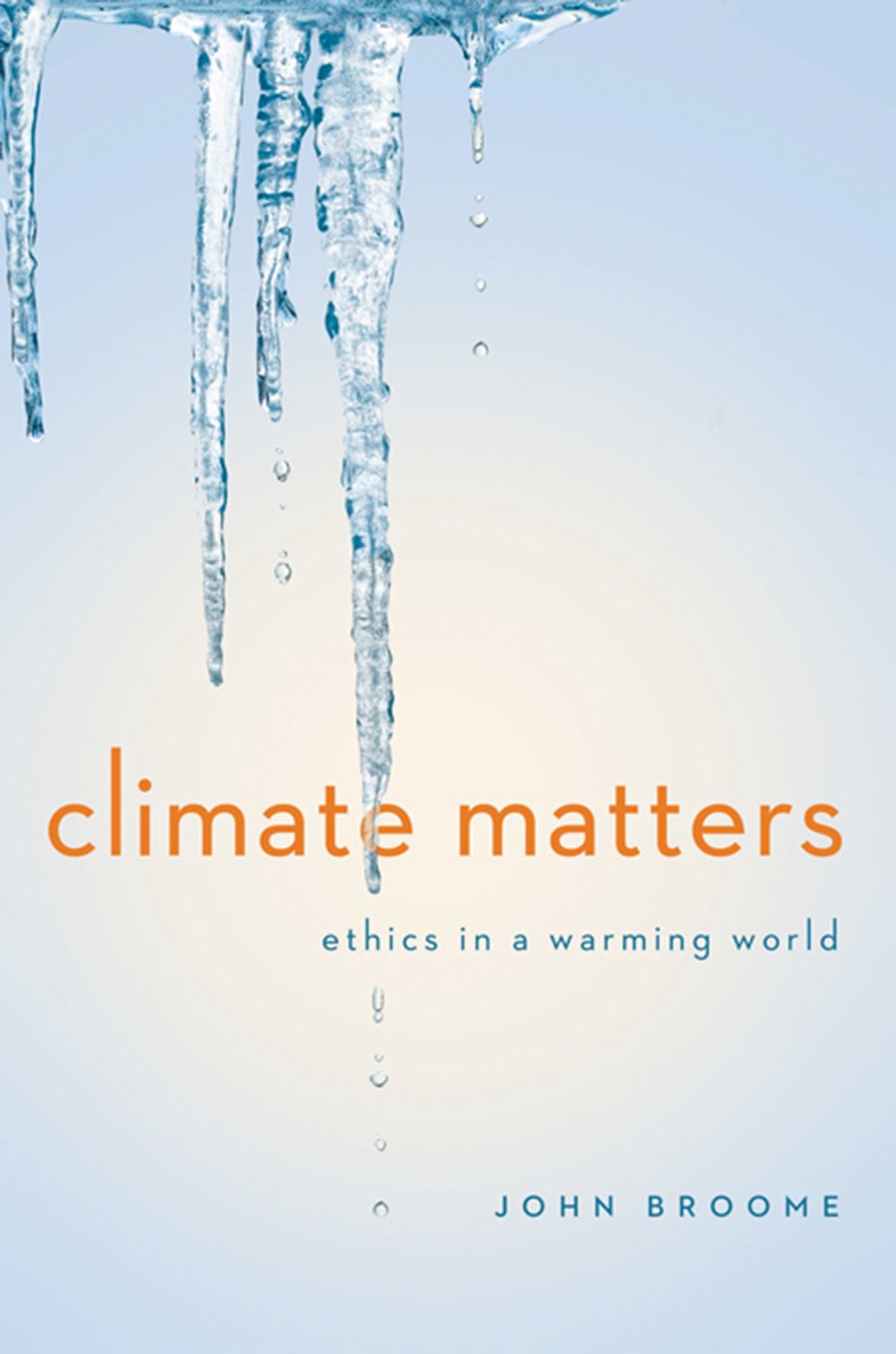
So far I read most of Climate Matters by John Broome, a philosopher at Oxford. It is a pretty easy read and relatively short. It's really good for a concise presentation of the important ethical considerations for climate policy and the pitfalls of economic analysis and cost-benefit analysis for climate change.
http://www.amazon.com/Climate-Matters-Ethics-Warming-ebook/dp/B007HXFGPW
I also read half of Stephen Gardiner's A Perfect Moral Storm. It is a longer and slightly more academic exposition about ethics and climate change. It is also very good, though. Gardiner incorporates more citations of other prominent thinkers and more thoroughly dissects opposing arguments.
http://www.amazon.com/Perfect-Moral-Storm-Ethical-Environmental/dp/0195379446

http://www.technologyreview.com/review/513526/climate-change-the-moral-choices/
So far I read most of Climate Matters by John Broome, a philosopher at Oxford. It is a pretty easy read and relatively short. It's really good for a concise presentation of the important ethical considerations for climate policy and the pitfalls of economic analysis and cost-benefit analysis for climate change.
http://www.amazon.com/Climate-Matters-Ethics-Warming-ebook/dp/B007HXFGPW
I also read half of Stephen Gardiner's A Perfect Moral Storm. It is a longer and slightly more academic exposition about ethics and climate change. It is also very good, though. Gardiner incorporates more citations of other prominent thinkers and more thoroughly dissects opposing arguments.
http://www.amazon.com/Perfect-Moral-Storm-Ethical-Environmental/dp/0195379446
Friday, May 31, 2013
Book on Corporate Social Responsibility
I just started reading the Market for Virtue, which is a book on corporate social responsbility (CSR) by David Vogel, a prominent professor at the UC Berkeley business school (Haas).
It basically is an overview of CSR and an analysis of its strengths as well as shortcomings.
In contrast, it cites examples of several prominent companies who have supported public policies that would apply to all firms so that the large companies wouldn't be at a competitive disadvantage or always be bearing the brunt of activism.
1. Starbucks supporting national health care
2. Wal-Mart backing raising minimum wage
3. Nike supporting internationally binding labor standards
It basically is an overview of CSR and an analysis of its strengths as well as shortcomings.
...an important shortcoming of CSR is its failure to appreciate the critical role of public policy in promoting more responsible corporate behavior
In contrast, it cites examples of several prominent companies who have supported public policies that would apply to all firms so that the large companies wouldn't be at a competitive disadvantage or always be bearing the brunt of activism.
1. Starbucks supporting national health care
2. Wal-Mart backing raising minimum wage
3. Nike supporting internationally binding labor standards
Saturday, July 30, 2011
Favorite Economist
I think I have a favorite mainstream economist now: Kenneth Arrow
Last weekend I went to Raven Used Books on Newbury Street. I got a book by Kenneth Arrow, the Limits of Organization. I just finished the first chapter, Rationality: Individual and Social, where he argues that "collective action can extend the domain of individual rationality."
I like how he frames the discussion about organization, trust, and social good.
I think everyone should read this in high school or maybe college. It would help people think about what markets, organizations, and governments are for. It is about ethics and how to form the value judgments about what we want as individuals and how we can cooperate.
Last weekend I went to Raven Used Books on Newbury Street. I got a book by Kenneth Arrow, the Limits of Organization. I just finished the first chapter, Rationality: Individual and Social, where he argues that "collective action can extend the domain of individual rationality."
Collective action is a means of power, a means by which individuals can more fully realize their individual values
I like how he frames the discussion about organization, trust, and social good.
I think everyone should read this in high school or maybe college. It would help people think about what markets, organizations, and governments are for. It is about ethics and how to form the value judgments about what we want as individuals and how we can cooperate.
Sunday, June 12, 2011
The Backstory : Aggressive Accounting
These days I've also been reading The Great Unraveling by Paul Krugman. It is his NYT columns from 2000-2002 mostly about how bad George W. Bush is. Today I was reading his columns about aggressive accounting and corporate governance. There are two things of note.
In 1995, Congress overrode a veto by Bill Clinton to pass the Private Securities Litigation Reform Act, which made lawsuits against companies and auditors "that engaged in sharp accounting practices."
In 1997-2000, after-tax profits stalled, but the S&P 500, the profits reported to investors grew 46%. Krugman attributes this to the changes in management theory and the advent of "principal-agent" theory. What's sad is that it is a well-meaning idea where managers' pay depends strongly on stock prices so that they have more accountability. I can see how before it may have seemed like managers were inefficient, maybe sometimes too generous to employees, and maybe out of touch with the needs of the company since they did not have as much invested in their own companies. Unfortunately, tying their compensation to stock prices gives them a big incentive to artificially boost those prices regardless of actual performance. The problem is that the real performance of a company will always be somewhat qualitative. It will always be some kind of combination of factors. Any quantitative measure can always be manipulated. That is something Deming said, too.
We are still trying to deal with the effects of these issues today. Back in 2001 I was still in high school and I had no idea who Paul Krugman was. All these things were happening, but I didn't really know. I just knew that Reaganomics and tax cuts are irresponsible. It is kind of weird to get the back-story now, especially knowing that I was there, too. It is a different sensation from reading about things that happened longer ago or in different countries. I am glad that I think I will have a better understanding of things happening going forward, but it's also a little strange knowing that millions of other people will continue to be unaware and just minding their own business as I was.
In 1995, Congress overrode a veto by Bill Clinton to pass the Private Securities Litigation Reform Act, which made lawsuits against companies and auditors "that engaged in sharp accounting practices."
In 1997-2000, after-tax profits stalled, but the S&P 500, the profits reported to investors grew 46%. Krugman attributes this to the changes in management theory and the advent of "principal-agent" theory. What's sad is that it is a well-meaning idea where managers' pay depends strongly on stock prices so that they have more accountability. I can see how before it may have seemed like managers were inefficient, maybe sometimes too generous to employees, and maybe out of touch with the needs of the company since they did not have as much invested in their own companies. Unfortunately, tying their compensation to stock prices gives them a big incentive to artificially boost those prices regardless of actual performance. The problem is that the real performance of a company will always be somewhat qualitative. It will always be some kind of combination of factors. Any quantitative measure can always be manipulated. That is something Deming said, too.
We are still trying to deal with the effects of these issues today. Back in 2001 I was still in high school and I had no idea who Paul Krugman was. All these things were happening, but I didn't really know. I just knew that Reaganomics and tax cuts are irresponsible. It is kind of weird to get the back-story now, especially knowing that I was there, too. It is a different sensation from reading about things that happened longer ago or in different countries. I am glad that I think I will have a better understanding of things happening going forward, but it's also a little strange knowing that millions of other people will continue to be unaware and just minding their own business as I was.
Economic Growth Theory vs Prosperity Without Growth
In Prosperity Without Growth, Tim Jackson, a member of the UK Sustainability Commission, presents a potential problem with the need for a constant rate of economic growth. I summarize his analysis in this review. In economics textbooks, growth is necessary and highly desirable to increase everyone's standard of living.
In economic theory, output is a function of capital, labor, and the state of technology.
Y=f(K,N,A)
However, it's generally rewritten as Y/AN=f(K/AN)
I=S -> I/AN = sY/AN = sf(K/AN)
If d = capital depreciation
Kt+1/AN = (1-d)Kt/AN + sf(K/AN)
Kt+1/AN-Kt/AN = sf(K/AN)-dKt/AN = 0 in steady state
sf(Kt/AN) = dKt/AN = I
if technology grows gA percent a year and the population grows by gN, then total investment must grow by d+gA+gN
Output must grow for investment to grow. In Prosperity Without Growth, Jackson points out that resource efficiency must grow faster than output, which implies output growth must become completely decoupled from resource use at some point. How can we do this? New business models? New technology? Information technology? Entertainment?
In economic theory, output is a function of capital, labor, and the state of technology.
Y=f(K,N,A)
However, it's generally rewritten as Y/AN=f(K/AN)
I=S -> I/AN = sY/AN = sf(K/AN)
If d = capital depreciation
Kt+1/AN = (1-d)Kt/AN + sf(K/AN)
Kt+1/AN-Kt/AN = sf(K/AN)-dKt/AN = 0 in steady state
sf(Kt/AN) = dKt/AN = I
if technology grows gA percent a year and the population grows by gN, then total investment must grow by d+gA+gN
Output must grow for investment to grow. In Prosperity Without Growth, Jackson points out that resource efficiency must grow faster than output, which implies output growth must become completely decoupled from resource use at some point. How can we do this? New business models? New technology? Information technology? Entertainment?
Thursday, December 2, 2010
Monday, October 11, 2010
Nonlinear Dynamics in Economics
Found a book of essays on nonlinear dynamics in economics, finance, and the social sciences. Looks like most of the authors are European.
Tuesday, April 6, 2010
Ok To Fail
article on Simon Johnson, economist at MIT who just put out a new book 13 Bankers. His coauthor James Kwak has a blog http://baselinescenario.com/ which looks interesting.
Thursday, March 18, 2010
Sell Short
Interesting piece from WBUR on some novels about the financial crisis by Michael Lewis like the Big Short.
And in the clip, they talk about how AIG was where the Wall Street firms got their money.
Burry figured that he could bet against pools of these subprime mortgage loans using an instrument called a "credit default swap," essentially insurance on a corporate loan. Burry persuaded the investment banks to create credit default swaps for the subprime mortgage market.
"As the pools of loans that are underneath these bonds start to default," Lewis says, the investment banks that gambled on the subprime mortgage loans were forced to send Burry money daily as the bonds went bad. "Wall Street firms, they were on the other side of the bets."
And in the clip, they talk about how AIG was where the Wall Street firms got their money.
William Edwards Deming
I recently bought a book by Deming on a whim without really knowing who he was. They were talking about him on the radio the other day, though, about how he is largely credited with improving Japanese management practices and manufacturing quality after WWII. I just started reading his book. He was the one who advocated for US manufacturing to move away from cheap goods and move to higher value higher quality goods. Actually, the US has been successful in doing this, but now the labor force has been put out of work. I wonder if he was wrong or if his suggestions were not implemented according to his intentions. He says that competition can be bad when people race to lower standards. Some of this is consistent with Daly's criticism of free trade. Production moves to places with lower environmental standards and workplace safety laws. It'll be interesting to compare his views with Forrester and Daly's along with more conventional economists like Krugman.
Saturday, February 6, 2010
Prosperity Without Growth Review

This book lays out the argument for a new macroeconomics model that does not depend on exponential GDP growth.
First, it explains the reasoning behind economic growth and why we depend on it right now. The motivation behind growth is that it has been a very effective way to raise the standard of living for everyone. However, in OECD countries, inequality has increased in the past 20 years, and the middle class has not seen an "income increase in real terms." (I would like to examine this claim further.) The report also makes the argument that continued increased incomes in developed nations has not increased living standards such as life expectancy, happiness, and education levels. In some ways, the argument is that this is about as good as it gets so further increased income only brings marginal gain.
Economic growth is needed because increased efficiency of labor in capital markets due to technological improvements implies that more things need to be made in order to maintain full employment. Labor is expensive and a rising cost because the point of growth is for incomes to grow. Thus, in order for more people to be making more money, more things have to be made and consumed.
In The New Paradigm for Financial Markets, George Soros traces the emergence of what he calls a 'super-bubble' in global financial markets to a series of economic policies to increase liquidity as a way of stimulating demand. Loosening restraints on the US Federal Reserve, de-regulating financial markets and promoting the securitization of debts through complex financial derivatives were also deliberate interventions...What emerges from all this is that the market was not undone by isolated practices carried out by rogue individuals. Or even through the turning of a blind eye by less than vigilant regulators. The very policies put in place to stimulate growth in the economy led eventually to its downfall. The market was undone by growth itself.
This reliance on economic and material growth is also not ecologically sustainable. Most economists argue that while economic growth is necessary, material growth can be decoupled from economic growth. This implies that technological improvements need to reduce carbon intensity (emissions/dollar) faster than GDP grows.
The Ehrlich equation is where I = impact, P is population, A is affluence or income level, and T is the technological intensity.
I = PxAxT
so total carbon emissions for 1 year is
C = P x $/person x gCO2/$
Therefore, total growth in emissions per year is population growth + income growth - technological improvements.
Carbon intensities have declined on average by 0.7%/year since 1990...Population has increased 1.3%/year and average per capita income has increased by 1.4%/year (in real terms) over the same period...Carbon dioxide emissions have grown on average by 1.3+1.4-.7 = 2%/year leading over 17 years to an almost 40% increase in emissions.
...
To achieve an average year-on-year reduction in emissions of 4.9% with 0.7% population growth and 1.4% income growth, T has to improve by approximately 4.9+0.7+1.4=7% each year. By 2050 the average carbon content of economic output would need to be less than 40gCO2/$, a 21 fold improvement on the current global average.
...Imagine a scenario in which incomes everywhere are commensurate with a 2% increase/year in the current EU average income...By 2050 the carbon content of each dollar has to be no more than 6gCO2/$. That's almost 130 times lower than the average carbon intensity today. Beyond 2050, of course, if growth is to continue, so must efficiency improvements. With growth at 2%/year from 2050 to the end of the century, the economy in 2100 is 40 times the size of today's economy. And to all intents and purposes, nothing less than a complete decarbonization of every single dollar will do to achieve carbon targets. Under some more stringent stabilization scenarios, by 2100 we will need to be taking carbon out of the atmosphere.
These goals for absolute decoupling are only about carbon intensity and the use of other resources such as water have their own constraints.
Finally, the other idea from this book that I really liked was the discussion on 'consumer culture.' The acquisition of material things, especially novel material things have become a part of communicating our social status and identity. "...we use a 'language of goods' to communicate with each other, not just about status, but also about identity, social affiliation, and even - through giving and receiving gifts for example - about our feelings for each other, our hopes for our family, and our dreams of the good life." This idea implies that while we have enough for our physical needs, people will never be able to have enough stuff, partly because as you acquire more income, you need to use more and more of it to participate in society.
Wednesday, February 3, 2010
Prosperity Without Growth
This past weekend, I finished reading Prosperity Without Growth: Economics for a Finite Planet by Tim Jackson. It is a book that is based on Jackson's work as a member of the UK Sustainable Development Commission, which put out a report called Prosperity Without Growth? A Transition to a Sustainable Economy. It is available for download here. It's basically the same as the book.
I highly recommend this.
I highly recommend this.
Subscribe to:
Posts (Atom)